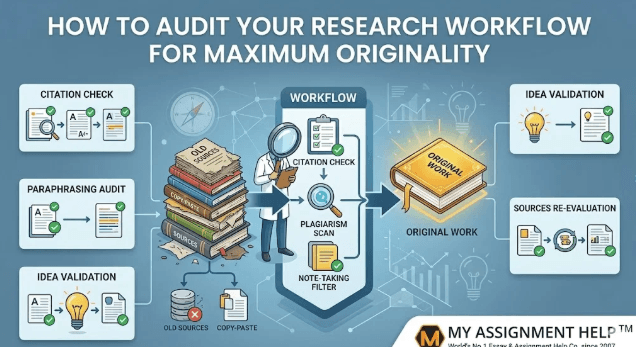
In an era where generative AI and digital databases make information more accessible than ever, the definition of originality has shifted. It is no longer just about avoiding a direct copy-paste; it is about the synthesis of ideas, the integrity of the research trail, and the ability to contribute a unique perspective to a saturated academic or professional landscape.
An unoptimized research workflow is often the silent culprit behind accidental plagiarism and “patchwork” writing. When your process for collecting, storing, and citing data is disorganized, the lines between your original thoughts and your sources begin to blur. To maintain high academic integrity and meet the rigorous standards of Expertise, Experience, Authoritativeness, and Trustworthiness (E-E-A-T), a systematic audit of your workflow is essential.
The Cost of a Fragmented Research Workflow
Research by the International Center for Academic Integrity suggests that a significant percentage of students and professionals who commit plagiarism do so unintentionally, often citing “poor note-taking” or “time pressure” as the primary causes. In the United States, academic institutions have seen a rise in “mosaic plagiarism”—where a writer lifts phrases from various sources and weaves them together without sufficient original contribution.
A disorganized workflow doesn’t just risk your reputation; it stifles creativity. When you are constantly searching for where a specific quote came from or trying to decipher your own scribbled notes, you lose the cognitive bandwidth required for high-level analysis.
Step 1: Evaluate Your Sourcing Strategy
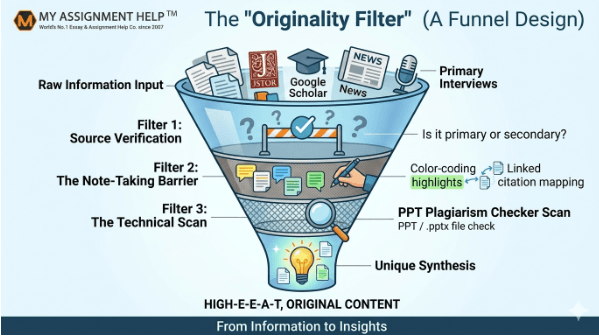
The foundation of originality lies in the diversity of your sources. Relying solely on the first page of search engine results leads to derivative content.
- Prioritize Primary Sources: Audit your recent projects. How many sources were peer-reviewed journals, government reports, or original interviews? If you are relying heavily on secondary blog posts, your work will likely echo existing sentiments.
- The “Three-Deep” Rule: For every secondary source you use, try to find the original data or study they are referencing. This allows you to interpret the data yourself rather than inheriting the previous author’s bias.
- Cross-Disciplinary Searching: Originality often happens at the intersection of two fields. If you are writing about economics, look for psychological studies on consumer behavior to add a fresh layer of depth.
Step 2: Formalize Your Note-Taking System
This is where most “originality leaks” happen. If you copy a quote into your notes without quotation marks, you may mistake it for your own summary three days later.
- The Color-Code Method: Use one color for direct quotes, another for paraphrased ideas, and a third for your own “lightbulb moments” or critiques.
- Source Mapping: Every single note must be tethered to a bibliographic entry immediately.
- Technical Verification: Before moving from the research phase to the drafting phase, use ppt plagiarism checker to scan your notes and preliminary outlines. This helps identify any phrases that may have been inadvertently lifted before they become embedded in your final manuscript.
Step 3: Strengthening the Synthesis Phase
Originality is the act of connecting dots that haven’t been connected before. If your writing feels like a summary of other people’s work, your synthesis phase is failing.
- The “Closed Book” Draft: After finishing your research, close all your tabs and books. Write the first few paragraphs of your argument from memory. This forces your brain to prioritize the concepts you’ve internalized over the specific phrasing of your sources.
- Gap Analysis: Look at your collected data and ask: “What is missing?” Originality is often found in the gaps—the questions the existing research hasn’t answered yet.
If the pressures of a complex research project or a tight deadline become overwhelming, it is often better to seek professional guidance than to risk the integrity of your work. Many students choose to pay someone to write an essay for you when they need a model of high-quality, original academic writing that adheres to strict institutional standards. This can serve as a benchmark for how to structure arguments and cite complex data correctly.
See also: How Cloud Technology Enables Global Scalability
Step 4: Data-Driven Auditing (The Technical Check)
A modern audit must include a technical review of the “Research Stack.” According to a 2023 survey on academic writing habits, 64% of high-achieving students utilize at least three different software tools to manage their research.
| Audit Metric | Goal | Tool Recommendation |
| Source Variety | >50% Primary Sources | Google Scholar / JSTOR |
| Citation Accuracy | 100% Match to Style Guide | Zotero / Mendeley |
| Originality Score | <5% Similarity Index | Professional Plagiarism Scanners |
| Structural Integrity | Logical Flow of Arguments | Mind-Mapping Software |
Step 5: Applying the E-E-A-T Framework
To ensure your work stands up to the scrutiny of both human readers and search engine algorithms, it must demonstrate:
- Expertise: Show deep knowledge through technical accuracy and nuanced understanding.
- Experience: Mention personal observations or unique case studies where applicable.
- Authoritativeness: Cite recognized leaders in the field and use high-authority domains.
- Trustworthiness: Provide transparent citations and avoid biased or unsubstantiated claims.
Key Takeaways
- Audit your sources to ensure a majority are primary and peer-reviewed.
- Use a distinct system for note-taking to prevent accidental plagiarism.
- Draft “blind” to encourage original thought synthesis.
- Leverage technology like plagiarism checkers early in the process, not just at the end.
- Focus on the “Gaps” in current research to provide a unique value proposition.
FAQ Section
Q: How often should I audit my research workflow?
A: Ideally, a “mini-audit” should happen at the end of every major project. A full structural audit of your tools and methods is recommended once every six months.
Q: Can I use AI in an “original” research workflow?
A: Yes, but only as a tool for brainstorming or organizing. The final synthesis and the actual writing must be human-led to maintain authenticity and E-E-A-T.
Q: What is the most common mistake in research workflows?
A: The most common mistake is “passive reading”—consuming information without taking structured notes, which leads to forgotten sources and unintentional borrowing of ideas.
Q: Is a low plagiarism score enough to prove originality?
A: Not necessarily. A low score means you didn’t copy text, but originality also requires “intellectual novelty”—providing a new perspective or a unique combination of ideas.
About the Author
Angelika S.
Senior Academic Consultant & Content Strategist
Angelika is a seasoned educator with over a decade of experience in academic writing and research methodology. Currently serving as a Senior Consultant at MyAssignmentHelp, she specializes in helping students navigate the complexities of higher education while maintaining the highest standards of integrity. With a background in curriculum development and SEO strategy, Angelika focuses on the intersection of technical accuracy and creative expression. Her mission is to empower writers to find their unique voice in an increasingly automated world.
References and Sources:
- International Center for Academic Integrity (ICAI). (2024). Statistics on Academic Dishonesty.
- Google Search Quality Evaluator Guidelines. (2023). Understanding E-E-A-T.
- University of Oxford. (2023). Effective Note-taking for Research Students.
- Harvard University Writing Center. (2024). Strategies for Avoiding Plagiarism.