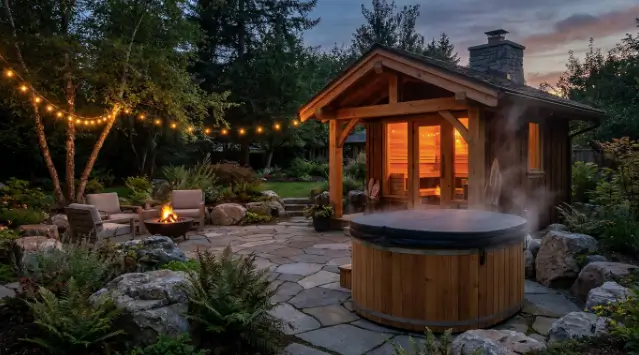
Most sauna kits need a level, well-drained base rather than a poured foundation: a compacted gravel pad, a paver base, or an existing wood deck rated for the load all work. A DIY gravel pad for a typical two-to-four-person kit footprint costs $300 to $600 in materials, a paver base runs $400 to $900, and a poured concrete pad, the most durable and most expensive option, typically costs $800 to $1,800 depending on size and whether it is hired out.
Does a Sauna Kit Actually Need a Permanent Foundation?
No, and this surprises a lot of first-time buyers who assume an outdoor structure needs concrete footings the way a shed or garage might. A cedar kit is lightweight compared to a framed building and distributes its weight across a floor kit or sill, so the real requirement is a flat, stable, well-drained surface that will not shift or pool water underneath the cabin. Bare soil fails on both counts over time, since it settles unevenly and holds moisture against the base of the walls, which is why gravel, pavers, or concrete are the standard choices rather than grass or dirt.
What Does a Gravel Pad Cost and How Do You Build One?
A gravel pad is the cheapest and most common base for a kit sauna. The basic build is a shallow excavation, roughly 4 to 6 inches deep, lined with landscape fabric to block weeds, filled with compacted crushed stone, and edged with plastic or metal landscape edging to keep the gravel contained. For a typical 4-by-6-foot or 6-by-8-foot kit footprint, materials run $300 to $600 for a DIY build over a weekend with basic tools. Hiring a landscaper roughly doubles that cost but saves the excavation and compaction labor, which is the most physically demanding part of the job.
What Does a Concrete Pad Cost Compared to Gravel?
A poured concrete pad is the most durable and most expensive of the common options, typically $800 to $1,800 for a small kit footprint depending on region and whether forms, rebar, and finishing are included. Concrete’s main advantage is long-term stability. It does not shift, compact unevenly, or need periodic topping-off the way gravel occasionally does. The tradeoff is that it needs to be sloped correctly during the pour for drainage, since a flat slab that holds standing water at the cabin’s base defeats the purpose, and once poured it is essentially permanent, unlike gravel or pavers that can be adjusted later.
Can a Sauna Kit Go on an Existing Wood Deck?
Often, yes, as long as the deck framing was built to carry the load. A small two-to-four-person cedar kit with people inside can concentrate 1,500 to 2,500 pounds over its footprint, which most decks built to standard residential code can handle, but an older deck, one with wider joist spacing, or one already showing sag deserves a quick structural check before a kit goes on it. Beyond load capacity, ventilation matters too: placing a kit directly on solid decking without any gap for airflow underneath can trap moisture against the deck boards over time, so a small air gap or shims under the kit’s floor kit is worth the extra hour of setup.
Does the Base Need to Be Perfectly Level Before the Kit Goes On?
Close to it, yes. A cabin set even slightly out of level can put uneven stress on door hinges and panel joints over time, which shows up eventually as a door that no longer seals flush or a small gap opening between wall panels. Most kit installation guides call for a base level within a quarter inch across the full footprint, checked with a long level or a laser level rather than eyeballing it. Gravel and paver bases are more forgiving here, since individual stones or pavers can be adjusted, tamped, or shimmed on the spot if a low spot shows up during a check. A poured concrete pad needs to be right the first time, since there is no adjusting it after the concrete cures, which is one more reason gravel or pavers appeal to a first-time installer working without a contractor’s crew.
What Does a Paver Base Cost, and How Does It Compare?
A paver base sits between gravel and concrete on both cost and effort. Interlocking concrete pavers set on a compacted sand and gravel bed typically run $400 to $900 in materials for a small kit footprint, DIY-friendly for anyone comfortable with basic landscaping work. The main advantage over concrete is flexibility: individual pavers can be lifted and releveled if the base settles unevenly after a season or two, something a poured slab cannot do without breaking it out. Once the base decision is made, it is worth matching the kit’s actual footprint to the pad dimensions before building, since resizing a gravel or paver base after the fact is far easier than resizing a poured one; see the full lineup of kit sizes to confirm the exact footprint before finalizing pad dimensions.
What Does the Research Say About Sauna Bathing Generally?
None of the foundation research above touches on health outcomes, but it is worth knowing what the broader research on regular sauna bathing says before investing in a permanent installation. A review in Mayo Clinic Proceedings summarized associations between regular sauna use and favorable cardiovascular markers across multiple cohort studies. A separate review examining sauna bathing alongside other lifestyle habits found the combination with exercise and diet was associated with added benefit over sauna use in isolation. A review in Mayo Clinic Proceedings from 2018 covering the broader evidence base described similar associations, all framed as population-level findings rather than guarantees for a specific individual.
Frequently Asked Questions
Does a sauna kit need a permanent concrete foundation? No. Most kits only need a level, well-drained surface. A compacted gravel pad or paver base works for most residential installations.
How much does a gravel pad for a sauna kit cost? A DIY gravel pad for a typical kit footprint usually runs $300 to $600 in materials. Hiring it out roughly doubles that.
Can a sauna kit sit directly on an existing wood deck? Yes, if the deck framing can support the load, typically 1,500 to 2,500 pounds concentrated over the footprint. Check older or lightly framed decks first.
Is a paver base or a poured concrete pad better? Both work well. Pavers are cheaper and easier to relevel later; concrete is more durable but costs more and cannot be adjusted once cured.
References
- Does the Combination of Finnish Sauna Bathing and Other Lifestyle Factors Confer Additional Health Benefits? A Review of the Evidence, Mayo Clinic Proceedings, 2023
- Effects of heat and cold on health, with special reference to Finnish sauna bathing, American Journal of Physiology – Regulatory, Integrative and Comparative Physiology, 2018
- Cardiovascular and Other Health Benefits of Sauna Bathing: A Review of the Evidence, Mayo Clinic Proceedings, 2018
By Diane Fischer